Stinging insect nest removal in Savannah requires specialized mechanical intervention because coastal Georgia humidity and extended warm seasons accelerate colony expansion between March and November. In neighborhoods…
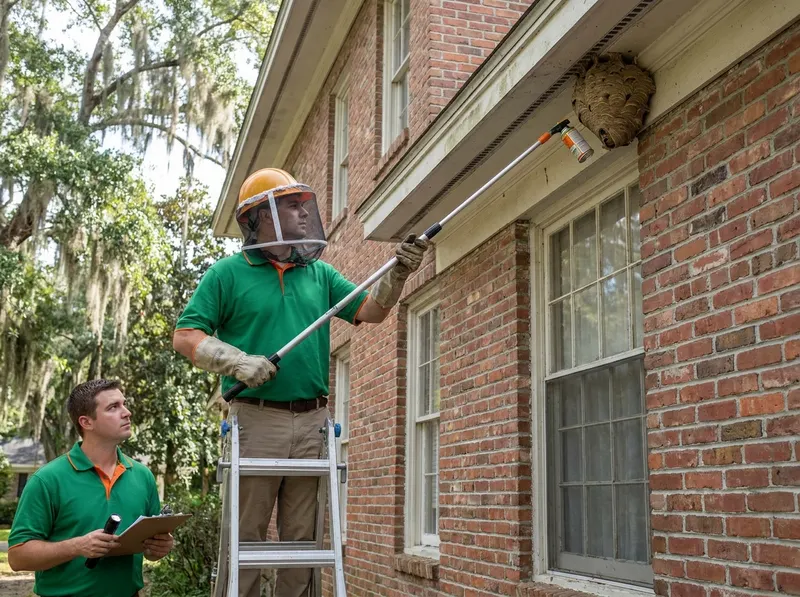
Stinging insect nest removal in Savannah requires specialized mechanical intervention because coastal Georgia humidity and extended warm seasons accelerate colony expansion between March and November. In neighborhoods like Ardsley Park, the Starland District, and the Victorian District, colonies frequently anchor inside deep heart-pine soffits, gingerbread trim, and decorative porch brackets. A standard surface spray from a retail aerosol can agitates species such as bald-faced hornets (*Dolichovespula maculata*) and southern yellowjackets (*Vespula squamosa*), triggering defensive swarms without penetrating the dense interior comb layers. In historic structures, attempting to spray a visible void often drives surviving workers deeper into interior living spaces through plaster lathe gaps. A professional extraction physically detaches the paper envelope, vacuums active flying workers using HEPA-filtered capture systems, and treats the void void face directly to break the chemical pheromone markers that signal insects to re-nest.
Ground-nesting yellowjackets present a distinct structural challenge in shaded, moist environments across Wilmington Island, Isle of Hope, and Skidaway Island. Nests established in abandoned rodent burrows or rotten oak root cavities beneath live oaks often expand undetected until reaching populations exceeding 1,500 workers by late August. For aerial species like paper wasps (*Polistes metricus*), open eaves and detached carriage houses in Gordonston and the Savannah Historic District provide sustained shelter from Atlantic wind bands. The eradication approach relies on targeted, low-odor insecticidal dusts applied via pressurized injection rods into the primary flight collar, followed by total substrate cleaning to strip residual attractants without staining historic masonry, raw cypress, or heart pine.
Selecting localized colony elimination over broad-spectrum broadcast spraying protects non-target pollinators and avoids lingering airborne odors inside the home. The trade-off involves access complexity: exterior soffit nests up to 20 feet high are treated and detached from telescoping extensions, whereas a hidden yellowjacket void behind heart-pine siding or within a crawlspace in Windsor Forest or Southside demands focused acoustic tracing and targeted thermal detection before opening a minimal, repairable service channel. Routine single-point treatments conclude in a single 60-minute visit, whereas structural voids necessitate a 48-hour observation window to ensure foraging workers returning from marsh cordgrass foraging points contact the residual barrier and expire.
Every job gets a firm, written price after a free on-site visit.
Tell us about your stinging insect nest removal job in Savannah and we'll send a clear, written quote, usually the same day.
 Calviro Pest Control