Roof rats (*Rattus rattus*) and house mice exploit the coastal architectural vulnerabilities of Chatham County, using mature live oaks near Forsyth Park and dense salt marsh vegetation near Skidaway Island to cross…
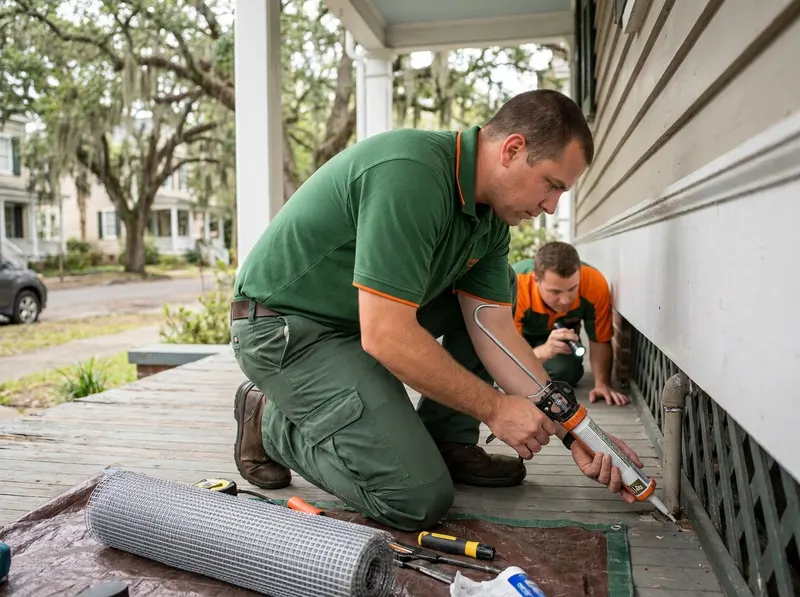
Roof rats (*Rattus rattus*) and house mice exploit the coastal architectural vulnerabilities of Chatham County, using mature live oaks near Forsyth Park and dense salt marsh vegetation near Skidaway Island to cross onto roof decks, chimneys, and crawlspace foundations. In the Historic District and Victorian District, multi-story heart-pine rafters and raised pier foundations contain historic settling voids that permit continuous rodent ingress. Standard chemical bait stations leave rodents to decay behind plaster walls, generating severe moisture-driven odors in humid coastal weather. Mechanical abatement replaces surface treatments with physical barricades, sealing masonry weep voids, chimney counter-flashings, and plumbing penetrations through foundation walls to arrest movement into the home envelope.
Properties in Ardsley Park, Gordonston, and Windsor Forest often feature open brick foundation vents and crawlspace ground clearances below 18 inches. Rodents travel these dark soil interfaces, gnawing through duct wrap, thermal fiberglass, and PVC condensate lines. In Wilmington Island and Isle of Hope, Norway rats take advantage of high water tables and tidal surges, pushing directly into ground-level subfloors and attached utility storage. Structural rodent exclusion utilizes heavy 19-gauge hot-dipped galvanized mesh across crawl vents and custom steel-sheet kick plates along exterior door sweeps. This physical barrier stops Norway and roof rats permanently without changing the exterior historic woodwork.
Rodent exclusion differs technically from routine quarterly pest spraying because it addresses structural physics rather than surface insect activity. An exclusion program requires three steps: first, completing an end-to-end exterior elevation survey mapping every breach 0.25 inches or larger; second, installing tamper-resistant steel materials that rodents cannot chew through; third, executing indoor snap-trapping check sequences over a 10-to-14-day duration until zero thermal camera movement is detected. While standard insecticide sprays manage perimeter beetles and ants, they produce zero deterrence against vertebrate pests. The operational trade-off requires an upfront investment in exterior carpentry and masonry closure rather than continuing perpetual toxic bait refills inside living quarters.
Every job gets a firm, written price after a free on-site visit.
Tell us about your rodent exclusion and abatement job in Savannah and we'll send a clear, written quote, usually the same day.
 Calviro Pest Control