Coastal Georgia conditions create extreme localized vector pressures. In Chatham County, where mean summer relative humidity consistently exceeds 75% alongside tidal marsh interfaces, mosquito proliferation is driven…
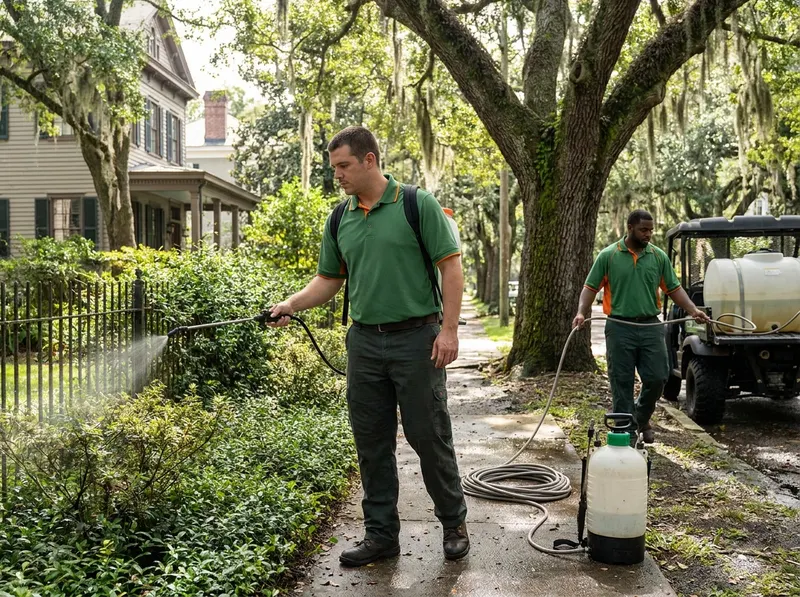
Coastal Georgia conditions create extreme localized vector pressures. In Chatham County, where mean summer relative humidity consistently exceeds 75% alongside tidal marsh interfaces, mosquito proliferation is driven by both container breeders and marsh varieties. Properties facing dense maritime oak canopies in Ardsley Park or water-adjacent lots along Isle of Hope encounter heavy populations of Aedes albopictus (Asian tiger mosquito) and Culex quinquefasciatus (southern house mosquito). Standard broadcast surface sprays disperse prematurely under coastal precipitation; effective suppression requires directional mist-blower deposition to target the abaxial leaf surfaces of broadleaf ornamentals, boxwoods, and azaleas where adults harbor during daylight heat spikes.
Decision-fit depends on foliage density and water proximity. If a property features an open turfgrass lawn with negligible perimeter shrubbery, targeted cultural control and gutter clearing are sufficient; if the property borders tidal estuaries or contains historic courtyard shade canopies like those found in the Victorian District or Starland District, specialized botanical residual barriers provide the necessary intervention. The operational trade-off centers on application boundaries: residual pyrethroids cannot be broadcast directly over open water or flowering pollinator beds, requiring buffer zones along brackish creeks on Wilmington Island and Skidaway Island while focusing chemical pressure on perimeter vegetation.
Structural execution follows three objective steps. 1. Technicians survey low-lying drainage depressions, clogged downspout lines, and ornamental containers, depositing Bacillus thuringiensis israelensis (Bti) larvicide into unmovable water reserves to stop development cycles within 24 hours. 2. Motorized backpack mist equipment delivers an electrostatic micro-droplet mist targeting the underside of leaves up to 10 feet vertically, creating a continuous boundary along fence lines, dense ivy beds, and foundation perimeters. 3. Application zones remain clear of human and pet traffic for 30 minutes until dried, establishing a residual rain-resistant barrier functioning for approximately 21 to 28 days without indoor air migration or harsh hydrocarbon odors.
Every job gets a firm, written price after a free on-site visit.
Tell us about your mosquito reduction and yard barrier treatment job in Savannah and we'll send a clear, written quote, usually the same day.
 Calviro Pest Control