Crawlspace pest exclusion and moisture management in Savannah addresses the specific architectural liabilities found across Chatham County, from raised brick piers in the Historic District and Victorian District to low…
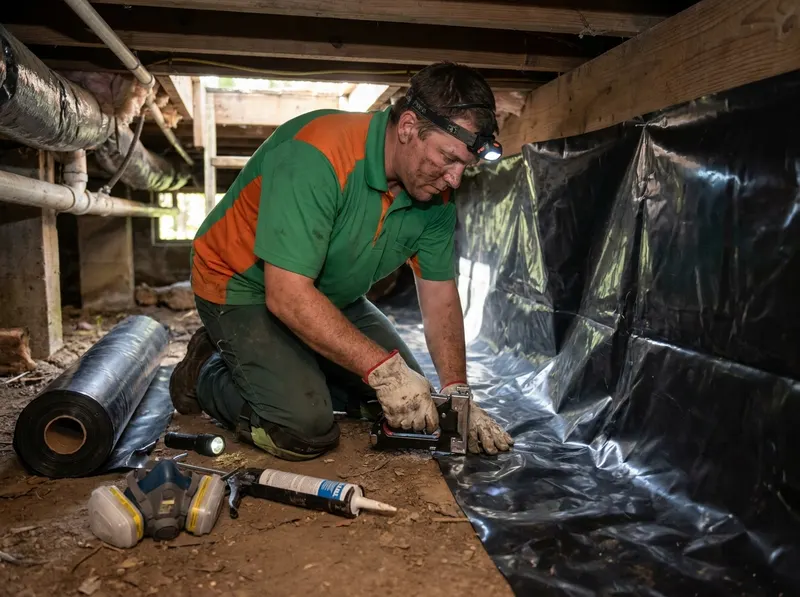
Crawlspace pest exclusion and moisture management in Savannah addresses the specific architectural liabilities found across Chatham County, from raised brick piers in the Historic District and Victorian District to low ground-clearance crawl foundations in Gordonston and Ardsley Park. In coastal Georgia, relative outdoor humidity regularly exceeds 80% during summer months. When warm, moisture-laden air enters passive perimeter foundation vents, it meets air-conditioned subfloors, causing condensation along wood joists, pine subfloors, and plumbing drops. Wood moisture content sustained above 19% creates prime structural targets for subterranean termites and provides the exact habitat required for wood-boring beetles, house mice, and smokybrown cockroaches. Structural pest defense therefore requires controlling subfloor psychrometrics rather than applying repetitive, short-lived surface chemical sprays that leave lingering odors inside living areas.
Technicians begin by measuring joist moisture percentages across multiple foundation bays using calibrated pin-probe meters, checking ground vapor barriers for breaches, and identifying mechanical entry voids around foundation vents, utility penetrations, and sill plates. In riverine settings like Wilmington Island, Isle of Hope, and Skidaway Island, high water tables often turn open ground crawlspaces into chronic vapor engines. The trade-off between passive venting and full encapsulation hinges on long-term mechanical air management versus immediate installation expense: passive repairs with crawlspace exhaust venting protect airflow but require strict monitoring, whereas multi-mil sealed vapor barriers with dedicated dehumidification completely isolate subfloor timbers from marsh dampness. Neither approach relies on locking property managers into restrictive 12-month auto-renewal contracts or utilizing broad-spectrum interior insecticides that risk staining antique heart-pine floors.
Properties in Windsor Forest and Southside constructed with concrete block curtain walls require quarter-inch steel wire cloth secured across foundation access doors and exhaust louvers to physically prevent rodent access. If wood moisture content registers below 14%, spot physical exclusion and partial vapor membrane repairs suffice; if structural framing registers above 20% with visible fungal growth, remediation includes targeted antifungal wood treatments, drainage diverters, and complete perimeter ground encapsulation. Standard protocol excludes chemical spraying on open ground standing water, focusing strictly on permanent physical barriers, foundation closure, and relative humidity reduction below 60% to suppress pest biology at the root source.
Every job gets a firm, written price after a free on-site visit.
Tell us about your crawlspace pest exclusion and moisture management job in Savannah and we'll send a clear, written quote, usually the same day.
 Calviro Pest Control