Subterranean termite treatment addresses the specific vulnerabilities of Chatham County's maritime climate, where sustained soil humidity exceeding 80% and sandy loam substrates accelerate termite tunneling. Unlike…
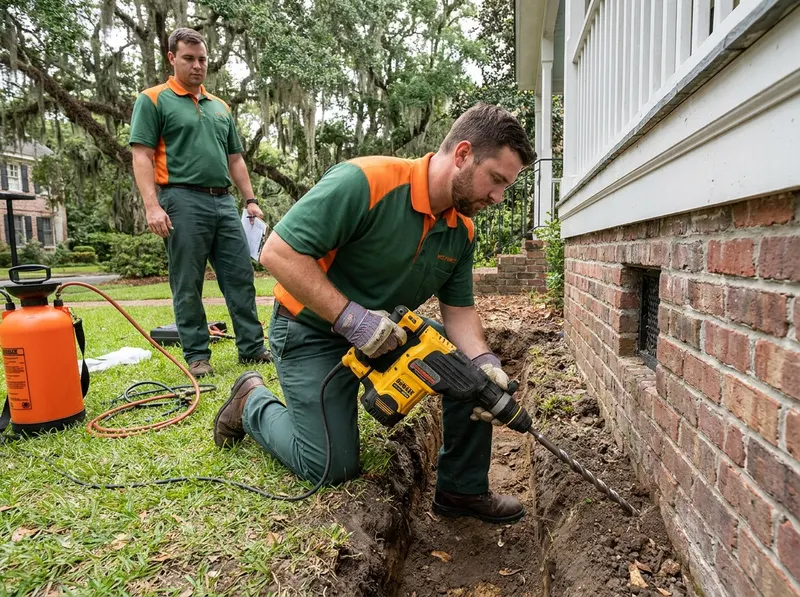
Subterranean termite treatment addresses the specific vulnerabilities of Chatham County's maritime climate, where sustained soil humidity exceeding 80% and sandy loam substrates accelerate termite tunneling. Unlike drywood species that nest inside ceiling joists, subterranean termites reside in the soil and construct vertical earthen shelter tubes across foundation footings to access structural wood framing. In Savannah neighborhoods like Ardsley Park, the Victorian District, and the Historic District, homes constructed on raised brick piers over exposed crawlspaces provide direct subterranean access points. Continuous non-repellent liquid soil barriers (utilizing fipronil formulations applied at 4 gallons per 10 linear feet) create undetectable treated zones. Worker termites unknowingly pass through the barrier, transfer the active agent throughout the colony via grooming, and eradicate the subterranean nest within 60 to 90 days.
Formosan subterranean termites present an intensified risk along the waterways of Wilmington Island, Isle of Hope, and Skidaway Island. These invasive colonies can house up to 10 million individuals and produce carton nests inside wall voids, avoiding ground contact once secondary moisture sources from roof leaks or coastal pipe condensation are established. For slab-on-grade homes common throughout Southside and Windsor Forest, horizontal liquid barrier treatments require precision sub-slab injection at 12-inch intervals along expansion joints, plumbing penetrations, and garage transitions. When historic heart-pine flooring or delicate antique brickwork precludes trenching, low-profile bait station arrays installed at 10- to 15-foot intervals around the exterior dripline intercept foraging termites using insect growth regulators (such as noviflumuron), terminating the population without odor or structural disruption.
Selecting between perimeter bait monitoring systems and full liquid trenching involves clear trade-offs between immediate barrier protection and long-term disturbance. Liquid soil trenching provides immediate exclusion along foundation perimeters for 8 to 10 years, but requires temporary soil displacement around landscaping and minor mortar-joint drilling on masonry porches. Exterior baiting systems avoid soil excavation entirely and provide passive, colony-level elimination through year-round monitoring, but require scheduled station inspections every 60 to 90 days. Neither protocol requires ongoing 12-month auto-renewal contracts or broad-spectrum surface sprays inside living quarters, keeping interior air uncompromised while shielding exterior load-bearing framing from sub-grade failure.
Every job gets a firm, written price after a free on-site visit.
Tell us about your subterranean termite treatment job in Savannah and we'll send a clear, written quote, usually the same day.
 Calviro Pest Control