Savannah's humid maritime climate and extensive tree canopy create ideal breeding environments for ectoparasites. In shaded parcels throughout Ardsley Park, Parkside, and Gordonston, deep leaf litter and damp soil…
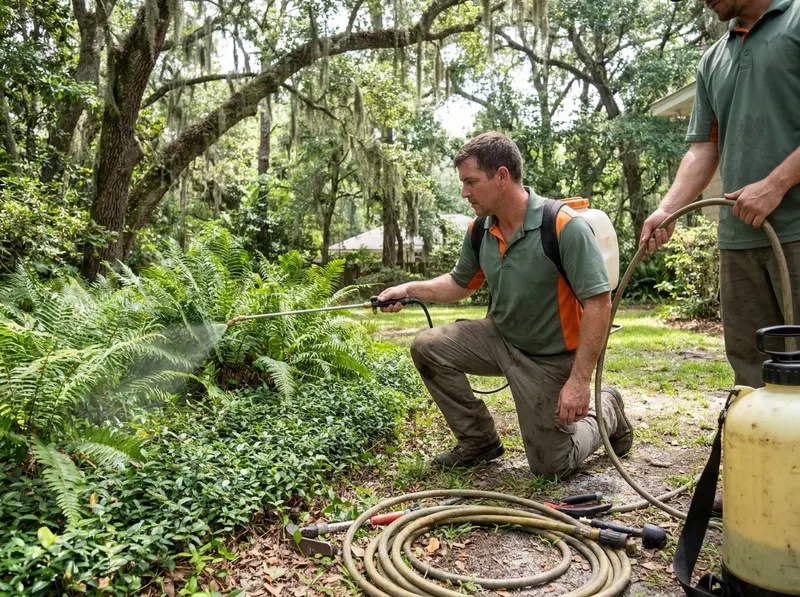
Savannah's humid maritime climate and extensive tree canopy create ideal breeding environments for ectoparasites. In shaded parcels throughout Ardsley Park, Parkside, and Gordonston, deep leaf litter and damp soil layers insulate flea larvae from natural heat mortality. The surrounding barrier islands, including Skidaway Island, Wilmington Island, and Isle of Hope, sustain heavy populations of white-tailed deer and marsh rodents that introduce lone star ticks directly into residential borders. Because standard broadcast sprays wash out under heavy coastal rains or fail to penetrate dense St. Augustine grass, targeted yard remediation relies on high-pressure liquid equipment that forces contact through the thatch layer directly into the soil crust.
Decision-fit for outdoor parasite suppression depends on the severity of the vector presence. When domestic pets show active parasite bites or adult pests become visible on lower brick foundations in the Victorian District, a dedicated exterior knock-down paired with an insect growth regulator stops population blooms immediately. Property managers facing an active parasite bloom choose specialized yard remediation over standard indoor-only dusting; the exterior perimeter harbors up to 90% of developing pupae in non-living matter like pine straw mulch and groundcover. The trade-off is environmental: liquid barrier applications require lawns to dry completely for 60 to 90 minutes before children or pets resume activity, and persistent rain can require a scheduled booster application 14 days later to intercept newly hatched cocoons.
Operational execution follows a four-step intervention designed to halt reinfestation from neighboring vegetation. Step 1: Technicians conduct a 360-degree perimeter assessment to map moist shade zones, livestock fence lines, and wildlife travel corridors. Step 2: High-pressure applications saturate ornamental beds, pine straw buffers, and crawl-space perimeter piers up to 3 vertical feet. Step 3: An insect growth regulator is blanketed across primary lawn expanses to halt larval chitin synthesis, rendering newly molted pests sterile. Step 4: Technicians clear standing debris pockets around stone footings near historic downtown homes, ensuring residual compounds remain stable against high coastal humidity.
Every job gets a firm, written price after a free on-site visit.
Tell us about your flea & tick yard remediation job in Savannah and we'll send a clear, written quote, usually the same day.
 Calviro Pest Control