Savannah crawl spaces experience relentless ambient humidity from the surrounding lowcountry marshes, driving moisture levels in structural framing past the critical 20 percent threshold where wood rot begins. In…
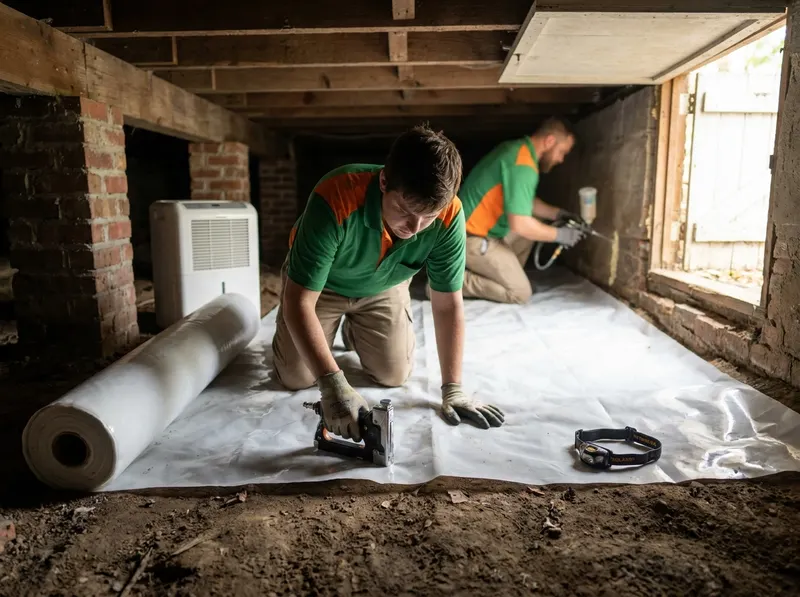
Savannah crawl spaces experience relentless ambient humidity from the surrounding lowcountry marshes, driving moisture levels in structural framing past the critical 20 percent threshold where wood rot begins. In historic neighborhoods like the Victorian District and Ardsley Park, homes resting on unsealed brick piers continually absorb moisture from the Chatham County water table through capillary action. Without closed encapsulation, humid summer air enters open foundation vents, condenses against cool air-conditioned subfloors, and saturates the timber. Encapsulation isolates the floor joists from raw soil, stops fungal decay, and deprives subterranean termites of the moist environment they require to construct mud shelter tubes.
Decision guidance relies directly on structural moisture measurements. If wood moisture content registers below 15 percent and ground dampness is limited to occasional rainwater pooling, a loose 6 mil vapor barrier and improved perimeter drainage resolve the problem. If subfloor timbers test above 19 percent moisture, support beams display white rot or surface mold, and cupping appears on interior hardwood floors, full encapsulation with an active dehumidifier is necessary. The trade-off is mechanical dependence: an open crawl space vents naturally but invites relentless damp air, whereas an encapsulated crawl space seals the envelope entirely but requires ongoing power to a commercial dehumidifier to regulate interior moisture.
Coastal island environments like Skidaway Island, Wilmington Island, and Isle of Hope face severe salt-air saturation and tidal water tables that make traditional passive foundation vents ineffective. In mainland communities such as Gordonston, Parkside, and the Southside, high summer dew points consistently feed mold colonies on fiberglass batt insulation, causing it to fall away from joists. Encapsulation resolves this by replacing sagging insulation with closed-cell wall insulation and taped poly seams, protecting the home against structural wood loss and damp pest harborages without requiring annual chemical termiticide re-applications on exposed soil.
Every job gets a firm, written price after a free on-site visit.
Tell us about your crawl space encapsulation moisture remediation job in Savannah and we'll send a clear, written quote, usually the same day.
 Calviro Pest Control