Roof rats in coastal Georgia exploit tree canopies to bypass ground-level defenses, requiring architectural intervention rather than simple poison stations. In Savannah neighborhoods with mature live oaks draped in…
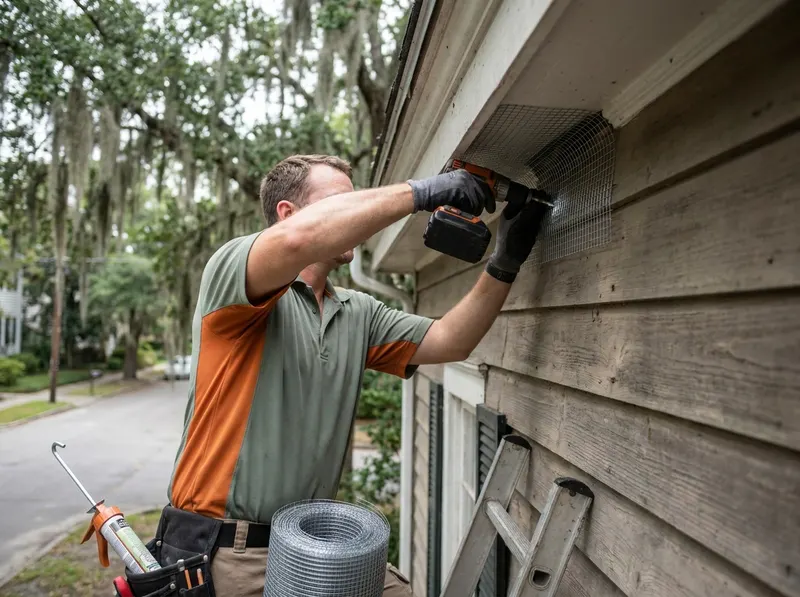
Roof rats in coastal Georgia exploit tree canopies to bypass ground-level defenses, requiring architectural intervention rather than simple poison stations. In Savannah neighborhoods with mature live oaks draped in Spanish moss, such as Ardsley Park, Isle of Hope, and Parkside, roof rats use overarching branches to access roof ridges, fascia gaps, and decorative corbels. A roof rat can compress its body through a gap measuring 0.5 inches wide, which matches the standard opening of an uncapped historic chimney or a warped coastal cedar soffit. Exclusion stops this access cycle by physically barring entry using 18-gauge galvanized steel hardware cloth, copper wire mesh, and metal flashing that rodents cannot chew through.
Historic District and Victorian District homes present distinct rodent dynamics compared to slab-foundation residences on Wilmington Island or Skidaway Island. Savannah timber frames, lath-and-plaster wall cavities, and raised foundation piers allow rodents to travel vertically from damp crawlspaces directly into attic insulation. Poison bait stations placed by national franchises often result in rodents dying inside inaccessible wall cavities, creating severe biological odor problems compounded by Chatham County's summer heat and 80% average humidity. Structural rodent exclusion prioritizes exterior mechanical barriers combined with interior snap-trapping runs, ensuring rodents are captured, physically removed from the premises, and prevented from re-entering.
Decision guidance depends on the rodent species and infestation location. If scampering noises occur high along ceilings, attic joists, or near upper-level fascia boards between 10:00 PM and 4:00 AM, the primary target is the arboreal roof rat, which requires high-elevation roofline sealing. If burrowing or foundation damage occurs around plumbing chases in Southside or Gordonston slab foundations, Norway rats are typically responsible, requiring low-elevation metal kick-plates and trench screening around footings. The trade-off between exterior trapping and complete structural exclusion comes down to long-term permanence versus upfront scope: trapping alone removes the current rodent population over a 14-day window but leaves exterior gaps open for re-colonization during the fall temperature drops, whereas architectural exclusion permanently seals the envelope against future colonies.
Every job gets a firm, written price after a free on-site visit.
Tell us about your roof rat & rodent exclusion job in Savannah and we'll send a clear, written quote, usually the same day.
 Calviro Pest Control